Mud tubes on the cellar wall: reading termite signs in a Rhode Island house
A pencil-wide line of dried soil on the foundation is easy to miss and worth a second look.
October 20, 2026 · 4 min read
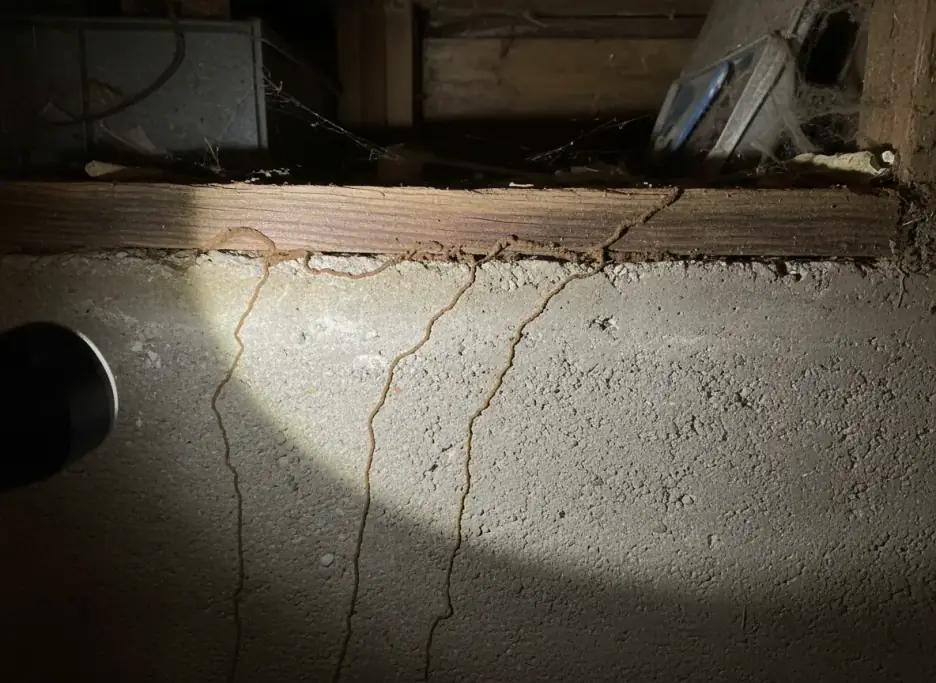
Most people find termites by accident. You go down to the cellar for a box of holiday decorations, sweep a flashlight along the top of the foundation, and notice a thin brown line running up the stone like a pencil mark. That line is worth stopping for.
What a mud tube actually is
Subterranean termites live in the soil and need moisture to survive. Open air dries them out, so when they travel from the ground to the wood in your house, they build covered tunnels out of soil, saliva, and bits of wood. The tunnels are usually about as wide as a pencil, though busy ones can be wider. They run along concrete, up fieldstone, over pipes, and across the face of a block wall.
A tube can be dry and dusty or damp and freshly built. Tap it with a screwdriver handle and an old one crumbles like dried mud. An old, empty tube does not always mean the trouble is over, and a fresh one does not always mean the colony is huge. Either way it tells you the same thing: something in the soil found a route into your house.
Where to look in a Rhode Island cellar
Older houses around Johnston often sit on fieldstone or poured concrete foundations, sometimes both in the same cellar where an addition went on in a different decade. Termites like the seams. Mortar joints in fieldstone crumble over the years and give them a hidden route up through the wall. Start your check at these spots:
- The top of the foundation wall, where the wooden sill plate sits on the stone or concrete
- The base of any post or column that stands on a dirt floor or a cracked slab
- Anywhere plumbing, a gas line, or a dryer vent passes through the foundation
- Behind the bulkhead stairs, where soil and leaves collect against the wall
- Under the porch and along the edge of any slab that touches the house
- Wooden steps or door framing that rest directly on the ground
Use a bright flashlight and hold it at a low angle against the wall. Raking light makes the ridges of a mud tube cast a small shadow, and that shadow is often the only reason you spot one against gray stone.
Signs that are not tubes
Tubes are the clearest sign, but they are not the only one. Termites eat wood from the inside, along the grain, and often leave a thin shell of the surface intact. A sill plate or joist that looks fine can sound hollow when you tap it, or the screwdriver can sink in farther than it should. Paint on a window frame that blisters or ripples for no obvious reason is another clue.
In spring, winged termites called swarmers leave a mature colony to start new ones. At a glance they look like flying ants. Swarmers have a thick, straight waist, straight antennae, and four wings of equal length. Ants have a pinched waist, bent antennae, and front wings longer than the back pair. A small drift of paired wings on a windowsill, with no insects attached, suggests swarmers got inside and shed them.
Mistakes that make the inspection harder
The natural reaction is to knock the tube down, spray something, and hope. Resist that. A broken tube gets rebuilt, or the termites open a new route somewhere you are not looking, and you lose the evidence that shows where they were headed. Leave it standing until someone has seen it.
Don't pull out damaged wood yet, either, and don't start hauling stored boxes away from the walls in a panic. You want the cellar to look the way it did when you found the tube. Take a few photos with a coin or a ruler in the frame for scale.
What to write down before you call
- Where the tube is, measured from a corner or a window so it can be found again
- Whether it is dry and crumbly or damp and fresh
- Any nearby wood that looks darkened, soft, or hollow
- Water trouble close by: a leaking pipe, a downspout emptying at the foundation, a damp corner
- Whether you have seen winged insects indoors in spring
- Past wood repairs or pest work on the house, if you know of any
Water matters because termites follow it. A downspout that dumps against the foundation, or a cellar corner that stays damp all year, makes a house more inviting. Fixing that will not remove a colony, but it takes away part of the reason they came.
Getting someone to look
Integrity Pest Control has been family owned and run for over 30 years, and termites are on the list of pests they handle in Johnston and the surrounding areas. If you have found a mud tube, or even a line you are not sure about, call (401) 467-3344 and ask for an inspection. Bring your photos and your notes, and the conversation gets a lot more specific, a lot faster.
Integrity Pest Control, (401) 467-3344
Call (401) 467-3344More articles
Why mice come in every October, and the gaps they use
The first hard cold snap sends field mice looking for a warm cellar, and they are good at finding the way in.
Ants on the windowsill: what the trail is telling you
Ants rarely wander. A trail has a start and an end, and both ends tell you something about your house.